Kermit famously complained that it wasn’t easy being green. I sometimes feel the same way about being a physicist. Even the most trivial daily sight can trigger thoughts about the inner workings of things.
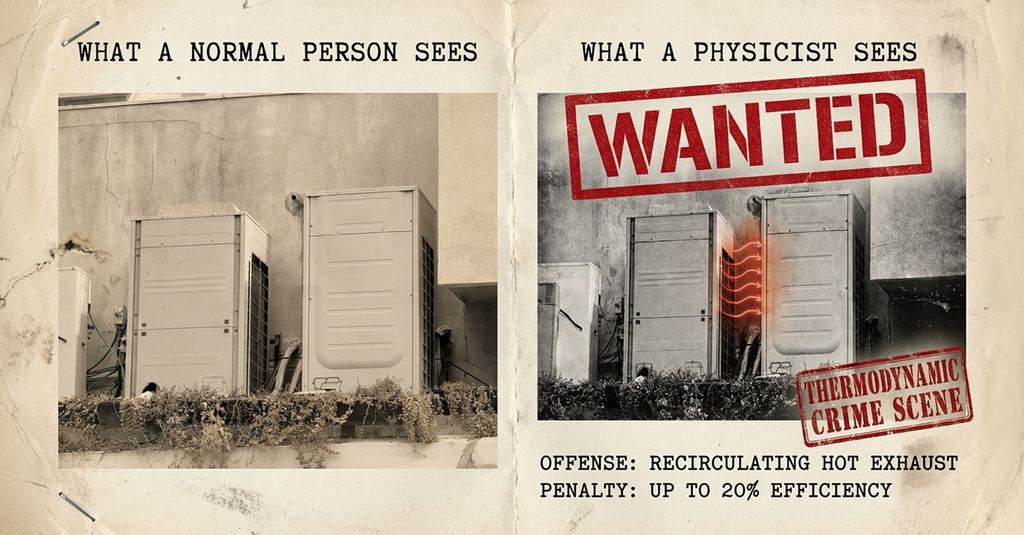
Recently, I noticed two air-conditioning units positioned so that one partially inhaled the hot exhaust of the other. To most people, they were simply two humming boxes. To me, it was a small thermodynamic crime scene, with a potential efficiency penalty of roughly 20%.
The reason is simple. Air conditioning does not “make cold”. It moves heat from one place to another, and the temperature difference it must bridge largely determines its efficiency. When one unit inhales its neighbor’s hot exhaust, it must work harder, consume more electricity and produce still more heat.
Most people would have kept walking. But as a physicist, I immediately started thinking about airflow, temperatures and efficiency, the hidden parameters of everything around us.
Looking back, it is not surprising that so many of the companies and technologies I have been involved with have really been energy problems in disguise.
In AI networking, the challenge is not simply moving bits fast enough. Every electrical conversion and every switching operation consumes energy and produces heat. Eventually, that heat limits how large the system can become.
AI networking has massive scale and the switch can become another thermodynamic crime scene. At 50 terabits per second, picojoules per bit produce hundreds of watts. Across a large AI fabric, those picojoules become kilowatts and eventually megawatts, all of which becomes heat and creates yet another cooling burden.The second law of thermodynamics is patient. It collects every one of them.
At sufficient scale, almost every information problem becomes an energy problem. It also reminds me of my good friend and mentor, the late Guy Sella, who always pointed out that the problems worth focusing on are around energy and friction. So yes, it is hard to be a physicist. But it is also rewarding, because it points you toward interesting problems that others may have learned to accept as unavoidable.
If hundreds or thousands of excellent engineers have already worked on a system, the breakthrough is unlikely to come from doing the same thing slightly better. The more interesting question is whether the architecture itself is rubbing thermodynamics the wrong way.
That is where I like to look. Find the thermodynamic crime scene. Follow the wasted energy and friction back to the architectural decision that created them. Once you did – the rest is just engineering. That is not just a physicist’s habit. It is also an investment thesis.thesis.