By Ofer Shapiro, CEO and Co-Founder of Resolight
How can an insight from a three bit switch help create the world fastest 1,000 Tbps switch?
There is a classic riddle about two rooms. In one room, there are three light switches. In the other, three light bulbs. You can arrange the switches however you want, but you may enter the second room only once. How do you figure out which switch controls which bulb?
At first, it feels impossible. Until you realize the answer lies in a dimension you were not using.
Turn one switch on and leave it on. Turn a second switch on for a while, then turn it off. Leave the third switch off. When you walk into the other room, one bulb is on, one bulb is off but still warm, and one bulb is off and cold. The problem becomes solvable the moment you stop thinking only in terms of “on” and “off” and start using heat as an additional dimension. Ok, so that’s a cool three bit switch, but how can it help us with modern data communication?
I have always loved that riddle because it captures something essential about creative breakthroughs. There is no recipe for invention. You cannot command ideas to appear. But many real breakthroughs do share one trait: they come from seeing a dimension others have left unexplored.
That pattern has shaped much of my career.
Years ago, I was part of building one of the first IP-based conferencing bridges, an MCU architecture that helped transform video communications and was licensed by major companies, contributing to RadVision’s path to the public market. Later, I worked on changing how video streams were encoded and handled, so that the network no longer had to rely so heavily on expensive transcoding. That became the basis for a video router architecture that dramatically improved density and efficiency.
Now, with Resolight I believe we are applying that same kind of thinking to one of the biggest bottlenecks in AI infrastructure.
Most people still talk about AI systems as if they are primarily about GPUs. They are not. At scale, AI is about networking GPUs efficiently.
That is where complexity, cost, power, and operational pain start to explode.
As clusters grow, networking becomes the limiting factor. Not just because bandwidth is hard to deliver, but because the cost of moving data, switching it, and coordinating it across the system becomes enormous. The industry has understood part of this problem, which is why so much attention is now going to optics, including CPO, LPO, and other optical interconnect approaches.
But there is a deeper issue.
If you move massive bandwidth over optics, only to convert it back to electronics at the switch, you have not removed the bottleneck. You have simply moved it one step down the road.It is like widening a highway and then forcing all the traffic through a stoplight at the next intersection.
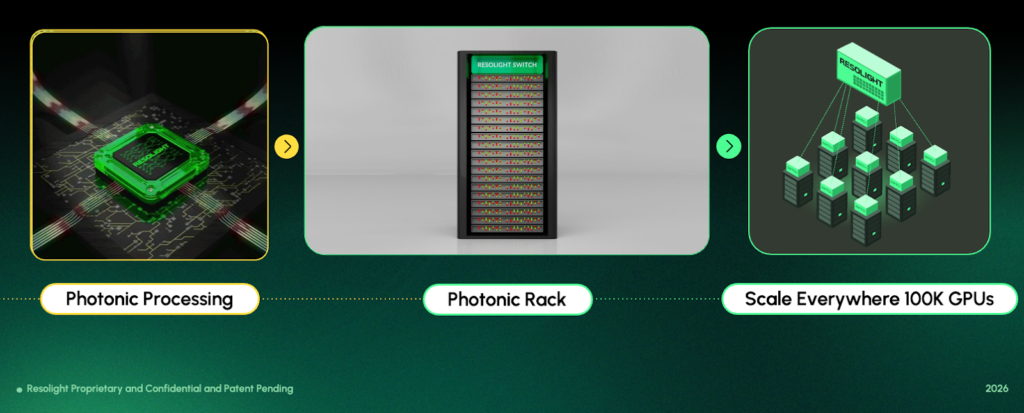
That is why optics alone are not enough. To unlock the next jump in AI infrastructure, optical connectivity has to be matched with photonic processing. In practical terms, that means an ultra-fast optical switch architecture that does not recreate the same electronic bottleneck in the middle of the network.
That is the core idea behind Resolight.
The key is not just switching faster. It is changing the way information is presented to the network in the first place.
Traditional switches are forced to comply with conventions and standards that assume a certain way of packaging and interpreting traffic. That assumption made sense when the network looked different. But when those same assumptions are carried into AI infrastructure at extreme scale, they impose massive inefficiencies. Sometimes the switch becomes so inefficient that the architecture itself stops scaling economically.
Our approach starts by asking a different question: what if the network did not need to inspect the payload at all?
What if the information about where data is going were separated from the data itself?
Once you look at the problem that way, a very different switching architecture becomes possible. With the right behavior at the endpoints, the switch does not have to read and process the content. It only needs to direct it. That opens the door to all-optical switching at extraordinary speeds, with nanosecond-scale reconfiguration.
This is the dimension that had been missing.
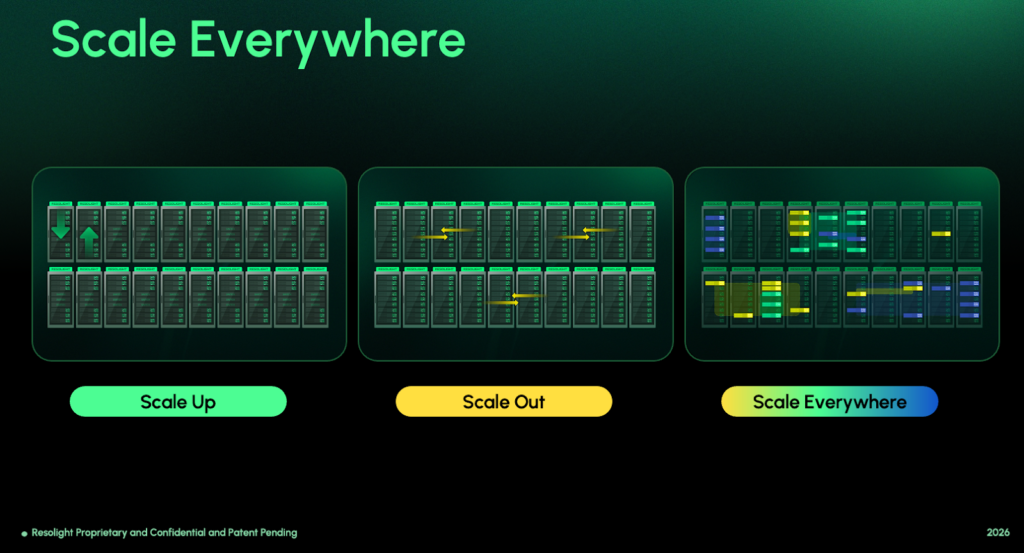
By separating destination from payload and combining that with ultra-fast photonic switching, we can build a network fabric that is far more scalable than conventional approaches. We believe this can improve energy efficiency and density by an order of magnitude, while enabling what we call scale everywhere: a more unified, more flexible AI network that is not trapped by the rigid boundaries of today’s architectures.
That matters because the AI world is entering a new phase.
For a while, the race was about raw capability. More GPUs. More links. More bandwidth. More capacity at any cost.
Now the industry is waking up to a harder truth: performance alone is not enough. AI infrastructure must also make business sense. It must be power-efficient, operationally efficient, and economically scalable.
That means the future will not be won only by better GPUs, or even by better optical I/O into electronic switches. It will be won by rethinking the network itself.
That is what we are building at Resolight. Not just faster links, but a different switching model. Not just more optical transport, but photonic processing that removes the next bottleneck instead of relocating it.
We believe this will be one of the breakthroughs that reshapes AI networking in the years ahead.
And like many breakthroughs, it begins by looking at the problem from a dimension others were not using. Learn more by reading an industry white paper that dives into the challenges of hyperscale datacenter networking and how Resolight’s technology transforms the economics and landscape of the optical switching, CPO and LPO markets or let’s connect.